

Can A Franchisor Require A Franchisee To Purchase A Product Or Service From Them?
Types of Franchises
There are three major types of franchises – business format, product, and manufacturing – and each operates in a dissimilar style.
Learning Objectives
Listing the different types of franchises
Key Takeaways
Cardinal Points
- A business format franchise is a franchising organization where the franchisor provides the franchisee with an established business, including proper name and trademark, for the franchisee to run independently.
- A product franchise is a franchising agreement where manufacturers allow retailers to distribute products and utilise names and trademarks.
- A manufacturing franchise is a franchising agreement where the franchisor allows a manufacturer to produce and sell products using its name and trademark.
Key Terms
- franchise: The authorization granted past a company to sell or distribute its appurtenances or services in a sure area.
Types of Franchises
While there are many ways to differentiate between dissimilar types of franchises (size, geographic location, etc), nosotros will be looking at how different franchisors permit franchisees to apply their proper noun. On this ground, there are 3 different types of franchise:
- Business organization format franchises
- Product franchises
- Manufacturing franchises
Business Format Franchises
In business organisation format franchises (which are the most common blazon), a company expands by supplying independent business owners with an established business, including its name and trademark. The franchiser company generally assists the independent owners considerably in launching and running their businesses. In return, the business organisation owners pay fees and royalties. In virtually cases, the franchisee also buys supplies from the franchiser. Fast food restaurants are skilful examples of this type of franchise. Prominent examples include McDonalds, Burger King, and Pizza Hut.

McDonalds: McDonalds is perhaps the near famous franchise in the world.
Product Franchises
With production franchises, manufactures control how retail stores distribute their products. Through this kind of agreement, manufacturers allow retailers to distribute their products and to utilize their names and trademarks. To obtain these rights, store owners must pay fees or purchase a minimum amount of products. Tire stores, for example, operate under this kind of franchise agreement.
Manufacturing Franchises
Through manufacturing franchises, a franchiser grants a manufacturer the right to produce and sell goods using its name and trademark. This blazon of franchise is common amid food and beverage companies. For example, soft drink bottlers often obtain franchise rights from soft drink companies to produce, bottle, and distribute soft drinks. The major soft potable companies also sell the supplies to the regional manufacturing franchises. In the instance of Coca Cola, for case, Coca Cola sells the syrup concentrate to a bottling company, who mixes these ingredients with water and bottles the product, and sells information technology on.
Advantages of Franchises
A franchise agreement can have many benefits for both the franchisor and the franchisee.
Learning Objectives
Discuss the advantages of participating in a franchise
Key Takeaways
Key Points
- Benefits to the franchisor include regular royalty payments, expansion with reduced financial take chances, and a greater geographical presence.
- Franchisee benefits include lower adventure, lower startup costs, existing brand recognition, and parent visitor marketing back up.
- Potential franchisees tin select a franchise based on their location, interests, resources, and needs, which ways that entering into a franchising arrangement can be a flexible process.
- – Royalty payments
- Franchisee benefits include:
- – Higher chance of success due to tried and tested business model
- – Franchisor support, training and expertise
- – Brand recognition and national marketing
Key Terms
- franchisor: a visitor or person that authorizes some other to sell or distribute its goods or services in a sure area
- royalty: Regular payment fabricated from the franchisee to the franchisor for the right to be a franchisee.
Benefits for the Franchisor
Franchisors benefit from franchise agreements because they permit companies to expand much more quickly than they could otherwise. A lack of funds and workers can cause a company to grow slowly. Through franchising, a company invests very little capital or labor because the franchisee supplies both. The parent company experiences rapid growth with little financial take chances.
A company can also ensure it has competent and highly motivated owners and managers at each outlet through franchising. Since the owners are largely responsible for the success of their outlets, they will put in a potent and abiding effort to make sure their businesses run smoothly and prosper. In addition, companies are able to provide franchising rights to only qualified people.
Other benefits include:
- Franchising allows a business organization to take an international presence.
- Franchisors can experience economies of scale.
- Franchisors can benefit from growth without worrying about running costs.
- Franchisors receive royalty payments that are fix as a percent of profits.
Benefits for the Franchisee
The franchisee also has numerous advantages that come from entering a franchising agreement, including:
– There is a low take chances due to the tried and tested formula. Buying a franchise business concern provides a higher chance for success. They get the benefit of owning a proven concern formula that has been tested and shown to work well in other locations. In addition, they receive the support from the principal company toward establishing the business concern, and the preparation to operate it successfully.
– There are lower outset-up costs since the business idea was already developed.
– They are buying a proper name and brand that is recognized by the public. Then they have a big advantage over starting a business from scratch, every bit they already accept an established customer base.
– A franchise gives more than security from the beginning. New contained businesses are known to have as loftier every bit a ninety% failure rate, often causing the business organization possessor heavy losses and at times defalcation.
– When you first a concern from scratch, you spend huge amounts of fourth dimension trying to operate the business without beingness successful because you may non have the necessary skills for that item area. When you purchase a franchise, all the necessary groundwork has been washed already. In add-on, the franchisee gets training and head office back up from the franchisor; this may be essential if the franchisee is new to running a business organization and has no feel or business knowledge.
– The franchisee gets the support of national marketing which a modest concern would non normally be able to afford. In some cases of larger brands, they may have customers waiting for their doors to open up (for example in a new McDonalds).
– Since all the product choice and the marketing take been already developed, you lot simply have to take care of the daily operations of the business organization. Your goal will exist to grow from an established foundation and expand from there.
– The new franchise owner gains many benefits from the association with the primary franchise company. The franchisor offers a great deal of business experience that would accept years for the average business concern person to acquire.

Pizza Hut Franchise: Franchisees gain many benefits from being a franchisee rather than starting their own business from scratch.
– There are a lot of office-time franchising opportunities, which are perfect if someone has a small corporeality to invest and wants to support themselves and maintain their investment. They may be able to sell the franchise to someone else once they no longer wish to run information technology.
Disadvantages of Franchises
A franchise agreement tin can also accept disadvantages for both the franchisor and the franchisee.
Learning Objectives
Discuss the disadvantages of participating in a franchise
Cardinal Takeaways
Key Points
- Disadvantages to franchisors include a lack of command over franchisees, reputational risks, and ho-hum growth through franchising compared to mergers and acquisitions.
- Disadvantages to franchisees include high costs and royalty payments, strict product rules, and other start up challenges.
- Entering into an agreement with an interested franchisor is important. Uninterested franchisors will not provide acceptable support, and are only interested in collecting fees and payments from franchisees.
- Franchisee disadvantages may include:
- – High entry costs, which include fees and kickoff-upwards capital, and ongoing royalty fees
- – Lack of support from uninterested franchisors
- – Lack of flexibility in how to trade, also as where to locate
Key Terms
- uninterested franchisors: Franchisors that have picayune interest in the actual success of the franchise, and more interest in collecting fees from franchisees.
Disadvantages to the Franchisor:
Of grade, no concern arrangement is without potential risks and disadvantages. While there are many advantages for the franchisor in entering a franchising agreement, some of the potential risks are:
– Difficult to control activities of franchisees: In any franchise understanding (peculiarly when in that location is geographical separation betwixt the franchisor and the franchisee), it can exist difficult to control the activities of the franchisee and ensure that their activities are up to standard.
– Huge take a chance in reputation by assuasive other businesses to apply their names: if a franchisee does not live up to the quality standards of the franchisor (cleanliness, customer service, pricing, quality of product, etc.), this can have a negative reputational effect not just on the franchisee, simply on the broader reputation of the franchisor too. Thus, there is a risk in allowing others non directly connected to the business to use the business concern name and trademark.
– Non as quick a method of growth as mergers or acquisitions: M&A allows companies to expand very speedily, whereas entering into franchising agreements means that the franchisor enters agreements with numerous individuals over time, and has to expect for them to start up and begin operations (instead of taking over existing operations). This method of expansion tin be slow.
Disadvantages to the Franchisee
– Loftier entry and ongoing price: It can be more than expensive to beginning a franchise than an independent business. You can open up your own burger bar for the fraction of the toll of buying the rights to a McDonald'south franchise. Thus, franchising is oftentimes an option open only to already wealthy businessmen.
– Franchisees have to pay a significant percent of their revenues to the franchisor: On top of the upfront money needed to outset a franchise, the franchisee must pay fees and royalties to the franchisor. The franchise fee may range anywhere from $five,000 to over $i one thousand thousand and hence can be a major expenditure for the franchisee. Royalties are paid periodically during the life of the franchise agreement. They are either a percentage of an outlet's gross income—usually nether ten percent of an outlet'due south gross income—or a fixed fee.
– Other franchise costs: In addition to royalties and payments, the franchisee may be required to purchase certain items from the franchisor like calculator systems and software.
– Uninterested franchisors: Some franchisors may have niggling interest in their franchisee'south success and may be more interested in just collecting the fees associated with the franchise. Thus, support and marketing may not exist adequately provided.
– Strict product rules: Franchisees experience less flexibility to use their own initiative due to restraints from the franchisor. Franchisees can but sell the products of the franchise, and they may exist tied into a national brand with a strict prepare of instructions about how they should trade.
– Start up challenges: The franchisee may take to find or build the right location, hire and railroad train staff and install equipment. This may be hard for someone with limited business skills just starting out.

Airtight store: Franchisees face risks and disadvantages that may jeopardize their ability to stay open.
Franchise costs vary to some extent because of costs associated with dissimilar kinds of businesses and with different locations. For example, a person who wishes to open a franchised employment service performance, such as Talent Force, based in Atlanta, Georgia, tin get away with every bit footling as a $7,500 fee, plus one year'due south starting capital investment of $50,000 to $110,000. On the other hand, start-upward costs for a company like J.O.B.Due south., based in Clearwater, Florida, can be as lilliputian as $45,000, including a $30,000 franchise fee.
Working from Dwelling or Online
Domicile franchise operations have made franchising more accessible and affordable than ever, but still crave knowledge and expertise.
Learning Objectives
Assess the factors driving the increase of home-based franchises
Cardinal Takeaways
Cardinal Points
- Abode based franchising allows those who do not have the resources to become traditional franchisees to get involved, due to the fact that there is no demand to invest in a dedicated business organisation infinite (lower cost), also every bit increased flexibility.
- This reduced cost is an advantage to both the franchisor and the franchisee.
- There are withal risks involved with home based franchising: franchisees must cull opportunities that they are suited for, based on their skills and expertise, as well as based on the local market.
Key Terms
- home based franchise: Home based franchises are ways of affiliating with organizations and working from home, oftentimes involving less investment than traditional franchises, sometimes even needing fiddling more than a calculator with an Internet connectedness.
1 important gene leading to the record number of franchises in contempo years is the proliferation of home based franchise opportunities. This has made franchising accessible to a wider group of people. Previously, franchising a business meant that a franchisee would demand to come with a huge cash investment. This was mainly to comprehend the franchise payment and to institute a real shop or business function, as directed past the business agreement. In some cases, this franchise fee is actually dwarfed in size past the toll of the volume needed for the business area.
Because of enormous charges in traditional franchise companies, very few people come across the expense needed to become franchise owners. With home based opportunities, you articulate abroad the demand to invest in a real business space by using your present home every bit a base of operations of operations instead. With a calculator and an Internet connectedness, people are oft ready to begin.

Working From Home: Often, your office could be your own home, and your laptop your primary asset.
Despite the advantages introduced past home based operation opportunities, a new business owner should not have the responsibilities and decisions lightly. Yous might have almost all the elements of operating and marketing your franchise–withal that does not mean that you tin just going to sit dorsum and let the organization practise all of the work for you. Franchising a successful home business does non necessarily hope that you volition always be assisting. In fact, even experienced businesspeople tin fail with a successful franchise when they do non choose the right home based opportunity.
In because franchises, y'all should see if you are well-suited to detail franchise options by determining your areas of expertise. Make up one's mind if your skill set is going to be an asset to the business concern. Thorough and honest assessment should guide which opportunities you consider, and y'all should explore your weaknesses besides. If you lot feel there are certain aspects of the franchise which may exist hindrances to your success, then skip those, even if the opportunity is otherwise tempting. For instance, if you lot have been an avid angler all your life, you should consider home based fishing franchise prospects. This tin can include things like selling line-fishing gear and other angling related items on the net or offering your services every bit a local fishing tour guide. But if you hate the idea of fishing, that one will probably not exist right for yous.
Technology in Franchises
Advances in technology benefits franchisors, franchisees, and the stop customers.
Learning Objectives
Give examples of how franchises are using technology to improve business operation
Key Takeaways
Fundamental Points
- New technologies, such as greater connectivity, mobile apps, and cloud engineering, ways that franchisors can spend less fourth dimension on training and back up and focus on value-creating initiatives.
- New technologies, such as the Pulsar Call Direction Software adopted by Pop-A-Lock, allow franchisees to improve serve customers and meet their needs.
- Being ahead of the technological curve as well allows franchisees to outdo their competitors in their local marketplace. Support from the franchisor in this respect means the franchisee does non take to adopt and larn how to employ new technologies by themselves.
Cardinal Terms
- cloud: Regarded as an amorphous omnipresent space for processing and storage on the Internet; the focus of cloud computing.
Dave Materson, Chief Engineering Officer of a franchise company in W Palm Beach, Florida believes that new technology benefits those who train franchisees, the franchisees themselves, likewise as their customers. Here'due south what he has to say about technology and franchises:
"Put our franchisees in the mix and tech "ease of utilize" shines through in a pronounced fashion. Our people are subjected to then many pulls at their time, the new technology available can really make a departure. Being able to price and schedule your work from whatever location is a dream come truthful. Could this exist whatever easier than with a tablet computer? No way! Storing files in the cloud for accessibility anywhere on whatever device is wonderful. Posting to social media in real time with pictures, links and information solidifies the conventionalities that each franchisee should "be the expert" in their local market. And nosotros at the Corporate Office are delighted for two reasons. Nosotros don't have to railroad train people on how to use the tools; technology has given us a large pb-in for this task. Most importantly, nosotros Exercise get to teach how utilize of the tools is beneficial to their business. We distribute data as to what our collective group finds successful. We focus more on the business of business instead of the buttons and gadgets that for years were the root of so much frustration for new franchisees. "
Franchisees are using technology in various ways. Here are but a few.
Saladworks
In the first quarter of 2010, Saladworks released 3 new technological advances for the franchise and its customers.
- MySaladworks 2.0 – upgraded company intranet
- FreshCart – new online ordering system
- iPhone App – mobile ordering app available for the iPhone, iPod Touch, and iPad.
Pop-a-Lock
In 2005 Pop-A-Lock adopted the use of the Pulsar Telephone call Management Software platform to assist in performing its dispatch functions. Pulsar is utilized to receive initial data from customers concerning their bug, regulates pricing of service based on standard pricing practices and local franchisee SOP and perform dorsum office functions for payroll and billing.
Pop-A-Lock utilizes T-Mobile as a corporate sustaining partner to provide phone, Blackberry and Internet services in many franchise markets. The franchise does utilise other phone providers based on specific coverage needs and the desires of the local franchisee.
The T.I.M.E.S (Technical Data Management and Commutation System) was adopted for Pop-A-Lock in 2007 from many other Locksmith companies in gild to provide a computer based reference system for Locksmith information including Key Generation procedures, Installation Instructions and other technical information. The TIMES plan utilizes an interactive system which allows users to submit data for consideration immediately in order to maintain the well-nigh current collection of data possible.
Question from Height New Franchises: What role does engineering play in your organization?
Respond from Robyn Elman: A big ane! To compete in any concern, being technologically savvy has its advantages. From mobile electronic mail and texting, to social media, to using the right software & phone systems. By staying on tiptop of all the latest technology, we accept not just been able to make the lives of our clients easier (making them fifty-fifty more satisfied with our visitor and services,) but have been able to out-compete other companies in the industry who aren't equally familiar or comfortable with the newest trends. If whatever franchisee is lacking in skills in any of these areas, we provide additional (free) training until they are comfortable and excited about what new technology has to offer them.

Technology in franchises: The utilise of new technologies, such every bit social media, apps, and smartphone connectivity, tin assist franchisees and franchisors to get the nearly out of their business concern.
Trends in Franchises: Growth
Franchising grew profoundly in 2001 to 2005, before stagnating and following the growth trend of the rest of the economy in the years that followed.
Learning Objectives
Identify the latest market trends happening in the franchising sector
Fundamental Takeaways
Key Points
- The franchising sector outgrew most other sections of the US economic system betwixt 2001 to 2005, growing 41% compared to other businesses' growth of 26% over that period.
- Following 2005, growth stagnated. Although the International Franchise Clan (IFA) predicts a revival in 2012, recent history shows that these predictions are questionable.
- Franchisers must not echo the mistakes of the past, when franchise growth was driven by an excess of debt aggregating. Information technology may be necessary to be more selective about choosing potential franchisees.
- Ultimately, an honest appraisal of the state of the franchising industry and the "expert 'ole days" is required.
Key Terms
- franchise: The authority granted by a company to sell or distribute its goods or services in a certain area.
Trends in Franchising
From 2001 to 2005, the franchising sector grew at a faster pace than many other sectors of the U.South. economy. Direct economic output expanded by over 41% from $625 billion to $881 billion, while economic output of other businesses grew by 26%, from $16 trillion to $20.i trillion. Employment generated by franchised businesses grew by 12.vi%, from 9.79 million to eleven million, compared to iii.v% for all businesses, from 132 one thousand thousand to 136.seven million. Payroll generated by franchised businesses grew 21.6% compared to 15.4% for all businesses.

McDonald's Franchise: Franchising is the practice of using another firm's successful business organisation model.
The International Franchise Clan reported that 2012 would be the yr that franchising rebounds. In its Franchise Business Economic Outlook for 2012, the IFA stated, "after three years of restrained growth, due to the recession and its lingering effects, franchise businesses bear witness signs of recovery in the year ahead. " The IFA went on to country that "franchise business growth has been restrained over the past three years due to underlying factors, such as the weak rebound in consumer spending, that take been a elevate on the economy as a whole. In improver, tighter credit standards have limited the formation of new franchise small businesses and the expansion of existing businesses. "
Every 6 months the IFA puts out a statement about how the tight lending standards are retarding the growth of franchising. While that is undoubtedly truthful, it would be helpful to learn exactly what the IFA deems as the optimal level of liquidity in the system. If the IFA is silently longing for the loose credit standards that reigned supreme in the middle of the last decade and so that perhaps is the wrong path down which to proceed. If information technology is not, and then it is incumbent upon the leadership to set forth with more than particularity the goals because liquidity in the system is inextricably linked to the franchise growth projections. And if that is the instance, then the growth rate that was experienced in the years leading up to the Great Recession cannot be the criterion for growth in the adjacent decade.
The economic outlook published for 2012 projects an increase of 1.9% in franchise establishments. But equally stated above, the i constant with the economic outlooks produced by the IFA over the last four years is that each year the reports alter many of the figures stated in the report of the previous year. The reports practice accept a convenient escape machinery in that all of the reports state that the numbers are "estimates. " In other words, neither the IFA nor the high powered accounting and consulting firms deputed to compile the reports know conclusively how many franchise establishments exist today. If you lot read the reports carefully you will run into that the PWC reports state that 2007 was the first time that there was enough data to even put forth a sound estimate. And so while 1.ix% may well be the advisable and realistic growth rate for 2012, given the track record of the reports put forth by the IFA, franchisers must exist more than than a little skeptical about the numbers that they provide.
Trends in Franchises: International Adoptions
Franchises can be a powerful strategic tool in expanding globally, which has resulted in various trends in international adoption
Learning Objectives
Recognize the value in international franchising, and why there are increasing trends in global adoptions
Fundamental Takeaways
Central Points
- Expanding a business to a new state or locale is complex culturally, linguistically, and legally.
- Franchising offers strategic solutions to these challenges by providing buying to local business owners who are in touch with the cultural climate.
- International franchising has various pros and cons for the franchisee, the franchiser, and the local governments. The advantages for all parties has created a positive trend in international franchising.
- Every bit companies expand globally using this strategy, the local understanding has evolved production and service offerings to ameliorate encounter the needs of the local consumers.
- These trends of international adoption are best seen at business like McDonald's, KFC, and 7-Eleven, where menus and production offerings can vary profoundly from region to region.
Cardinal Terms
- BRIC: An acronym for Brazil, Russian federation, India, and China, which have some of the fastest growing economies in the world.
- franchisee: The individual who is granted a franchise and opens the new branch of a visitor in a local area.
- franchiser: The parent company that provides the brand assets to the franchisee.
International expansion is complex for both legal and cultural reasons, and franchising is a uniquely strong solution for both. The concept of franchising enables organizations to expand their business through empowering locals in a given expanse to open a business location representing the parent company'due south brand, operational strategy, and products.
The Pros and Cons
When considering the electric current trends in franchising from an international perspective, it'southward important to understand why organizations do this, why individuals are interested in opening a franchise, and why governments are open up to assuasive this approach. Let's have a quick await at the benefits of global franchising, and where the potential pitfalls are:
Pros
- For the franchiser (i.e. the parent visitor), franchising allows rapid expansion with less risk and required capital (as some of this risk is causeless by franchisee, along with funding).
- For the franchiser, success is closely tied to understanding the culture and language of a given area. A franchising model can provide both.
- For the local government, jobs are created and buying remains local.
- For the franchisee, they are given an opportunity to own a business with an incredible pool of resources, knowledge, and support.
- For the franchisee, much of the initial business organization programme, sourcing, quality control, marketing, and other core functions are already prepared, tried, and tested.
Cons
- The franchiser is outsourcing some amount of control and returns on investment to the franchisee.
- The franchisee, as a event, is incurring a substantial cost. As of 2010, opening a McDonald's franchise could cost anywhere from around $1 million to effectually $2 1000000 (USD).
- For local governments, in that location are a bully deal of legislative and contractual considerations when allowing franchising into the economy. Ensuring each political party acts legally and ethically requires resource.
While these lists could both be expanded a nifty deal, this should provide some context for the why backside the high volume of global franchising.
Trends in International Adoptions
The number of global franchises has seen a great deal of expansion in recent years, specially with emerging economies (such as the BRIC grouping) seeing substantial growth and increased purchasing power. Considering the cultural advantages discussed earlier, franchising has too seen some unique trends in adopting cultural perspectives and adapting production offerings.
A nice example of adopting cultural tastes can exist see in the fast food industry. McDonald'southward, KFC, and a variety of other pocket-size food chains take distinctly different carte items depending on where in the earth you are when you visit one of these chains. Convenience stores that franchise, such equally vii-Eleven, operate quite similarly. Agreement local demand and local availability of certain products changes what the consumer in those areas are offered. These cultural adaptations allow globally expanded companies to compete effectively throughout the world.
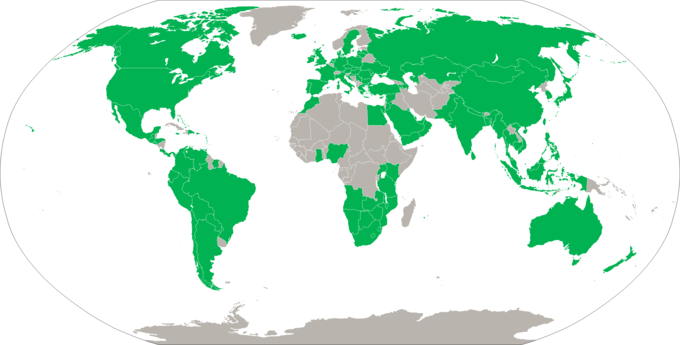
KFC Globe Operations: Equally of 2014, KFC carried out operations in all of the countries highlighted in green. Localizing, adapting to civilisation, and expanding their scope to this level of global operating is evidence of just how advantageous franchising can be equally an expansionary tool.
Franchise Agreements
A Franchise Understanding is a legal, bounden contract between a franchisor and franchisee, enforced in the U.s.a. at the State level.
Learning Objectives
List the items included in a franchise agreement
Key Takeaways
Fundamental Points
- The Franchise Agreement can vary in content depending on the franchise organisation, also every bit the state in which the franchisor, franchisee and arbitrator are based.
- The typical franchise agreement contains a number of documents including the UFOC or the FDD. It also defines the parties involved, the franchise system, trademarks, license in formation, length of understanding, and other key information pertaining to the franchise.
- The UFOC or FDD is a legal certificate which is presented to prospective buyers of franchises in the pre-sale disclosure process in the Us.
Primal Terms
- franchise rule: defines the acts/practices that are considered unfair or deceptive in the Usa franchise manufacture. It is published past the FTC.
- Franchise Disclosure Document: a legal document which is presented to prospective buyers of franchises in the pre-auction disclosure process in the United States.
A Franchise Agreement is a legal, binding contract between a franchisor and franchisee, enforced in the United States at the State level.
Prior to a franchisee signing a contract, the US Federal Trade Commission regulates information disclosures under the authority of The Franchise Rule.The Franchise Rule requires that a franchisee exist supplied a Uniform Franchise Offering Circular (UFOC ) or Franchise Disclosure Document (FDD ) prior to signing a franchise agreement, a minimum of ten days earlier signing a franchise agreement.
Once the Federal ten-24-hour interval waiting period has passed, the Franchise Agreement becomes a State level jurisdiction certificate. Each state has unique laws regarding franchise agreements.
The content of a franchise agreement can vary depending on the franchise system, the state jurisdiction of the franchisor, franchisee, and arbitrator.
A typical franchise understanding contains:

Legal documents: Franchising agreements contain many legal documents that must be understood and filled out.
- Uniform Franchise Offering Circular (UFOC) or FDD Franchise Disclosure Document (FDD)
- Disclosures required by state laws
- Parties defined in the agreement
- Recitals, such as Ownership of System, and Objectives of Parties
- Definitions, such equally: Agreement, Territory Expanse, Area Licensee, Authorized deductions, Gross Receipts, License Network, The Organization Transmission, Trademarks, Showtime Date, Trade name, Termination, Transfer of license.
- Licensed Rights, such equally: Territory, Rights Reserved, Term and Renewal, Minimum Performance Standard
- Franchisors Services, such equally: Administration, Collections and Billing, Consultation, Marketing, Manual, Preparation
- Franchisee Payments, such as: Initial License Fee, Training Fees, Marketing Fund, Royalties, Renewal fee, and Transfer fee
- Franchisee Obligations, such as: Use of Trademarks, Financial Information, Insurance, Financial and Legal responsibleness
- Human relationship of Parties, such as: Confidentiality, Indemnification, Non-Compete
- Transfer of License, such as: Consent of franchisor, Termination of license, Termination past licensee, Termination by licensee
- Other provisions
- Governing constabulary
- Amendments
- Waivers
- Arbitration
- Severability

Source: https://courses.lumenlearning.com/boundless-business/chapter/franchising/
Posted by: wisefeseracke.blogspot.com
0 Response to "Can A Franchisor Require A Franchisee To Purchase A Product Or Service From Them?"
Post a Comment